



Ductless mini-split systems give Vancouver homes year-round heating and cooling without ductwork, often at 250 to 350 percent efficiency. Single-zone installs run $4,500 to $7,500. Multi-zone installs run $9,000 to $25,000. Per the CleanBC Better Homes program, qualifying cold-climate mini-splits may receive up to $6,000 back, depending on eligibility. This guide covers when mini-splits make sense, when they don’t, and what the real numbers look like for a Vancouver home.
Content reviewed by Vanheat Services’ Red Seal certified HVAC technicians and Technical Safety BC licensed gas fitters. Last updated May 2026.
- Single-zone install: $4,500 to $7,500 (one outdoor unit, one indoor head)
- Multi-zone install: $9,000 to $25,000 (one outdoor unit, 2 to 5 indoor heads)
- Efficiency: 250 to 350 percent (COP 2.5 to 3.5) versus 100 percent for electric baseboard
- Cold-climate rated: Maintains capacity to -15°C, continues operating to -25°C
- CleanBC rebate: Up to $6,000 on qualifying heat pump installations, subject to program eligibility
What a Ductless Mini-Split Actually Is
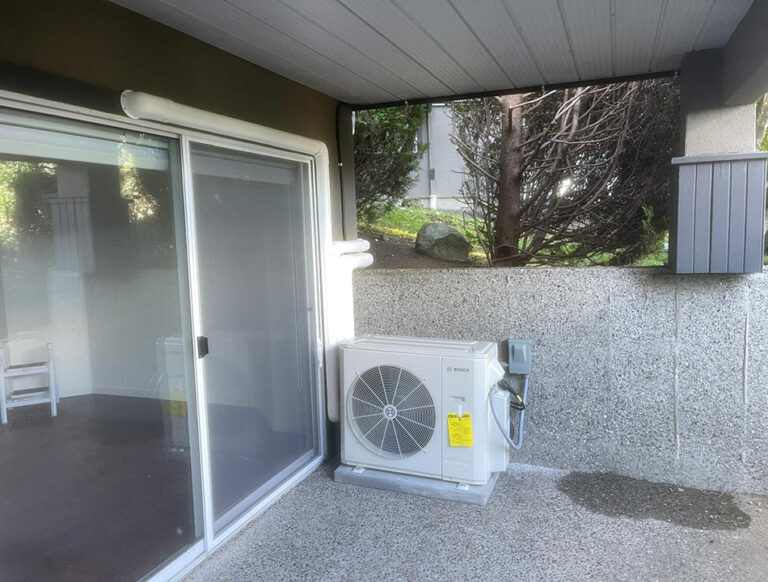
A ductless mini-split is a heat pump. The system has two parts: an outdoor compressor unit and one or more indoor heads. The two are connected by a small refrigerant line and electrical wiring routed through a hole in the wall, typically about 3 inches across. There are no air ducts. The outdoor unit moves heat in or out depending on the season, and the indoor heads deliver conditioned air directly into each room.
Indoor heads come in three styles: wall-mounted (most common, lowest cost), ceiling cassette (built into the ceiling, more discreet), and floor-mounted (good for basements or rooms with limited wall space). A single outdoor unit can connect to up to 5 indoor heads in a multi-zone configuration.
Mini-splits work like a heat pump but without ductwork. They run at 250 to 350 percent efficiency, replace electric baseboard heating outright, and qualify for the CleanBC rebate when fuel-switching from fossil fuels. The trade-off: each room needs its own indoor head, which is more visible than a forced-air register.
Six Real Benefits of Ductless Mini-Splits in Vancouver Homes
Most blogs list 10+ benefits and pad the list. The benefits that actually drive Vancouver homeowners to install mini-splits are these six.
Year-round heating + cooling in one system
A mini-split heats in winter and cools in summer using the same unit. Replacing a furnace plus separate AC with one mini-split eliminates redundant equipment and reduces the maintenance footprint.
250 to 350 percent efficiency
Heat pumps move heat rather than create it. Per unit of electricity, a cold-climate mini-split delivers 2.5 to 3.5 units of heat. Electric baseboard delivers 1 unit per unit. Gas furnace at 96 percent AFUE delivers 0.96 units. The efficiency gap drives the savings math.
Per-room temperature control
Each indoor head has its own thermostat. The bedroom can be 18 degrees while the living room is 22. Empty rooms can be set lower with no impact on occupied rooms. This is impossible with a single-zone forced-air system.
No ductwork required
Old Vancouver homes built before 1960 often have no ducts. Adding ductwork to retrofit central HVAC costs $8,000 to $15,000 in finished ceiling and wall repair alone. Mini-splits skip this entirely.
CleanBC rebate up to $6,000
According to the CleanBC Better Homes program, qualifying cold-climate heat pump installs that fuel-switch from fossil fuels may receive up to $6,000 back, depending on eligibility. Per the Canada Greener Homes Loan, the upgrade can be financed with up to $40,000 interest-free.
Quieter than central HVAC
Indoor wall-mounted heads run at 19 to 32 dB on low fan speed (quieter than a refrigerator). Outdoor inverter-driven compressors rarely run at full load and average 50 dB. Bedrooms with mini-splits typically run quieter than rooms heated by ducted forced-air systems.
When a Mini-Split Is the Right Call (and When It Isn’t)
Mini-splits aren’t universally the best answer. Here is the honest tradesperson view of where they make sense and where they don’t.
| Scenario | Mini-split fit |
|---|---|
| Older Vancouver home with no ductwork (electric baseboard) | ✓ Strong fit. Direct replacement of inefficient baseboard, qualifies for CleanBC rebate, big efficiency gains. |
| Basement suite or finished basement | ✓ Strong fit. Single-zone wall or floor unit handles year-round comfort without ductwork extension. |
| Addition or sunroom not connected to main HVAC | ✓ Strong fit. Adding a mini-split is cheaper than extending ducts. |
| Master bedroom that runs hot or cold | ✓ Strong fit. Single-zone unit gives independent control without rebalancing the whole HVAC system. |
| Whole-home replacement of forced-air gas furnace + central AC | ~ Possible but compare with central air-source heat pump. Multi-zone mini-split costs $18,000 to $25,000 vs $14,000 to $20,000 for a central heat pump that uses existing ductwork. |
| Newer home with working forced-air gas furnace | ~ Mixed. Adding a mini-split to one problem room makes sense. Replacing the entire system rarely does until the furnace fails. |
| Strata or condo with restrictive bylaws | ✗ Check first. Many Vancouver stratas restrict outdoor unit placement. Some require board approval. Bylaws vary widely. |
| Heritage home where wall-mounted units are aesthetically unacceptable | ✗ Consider ceiling cassette or ducted concealed mini-split (more expensive but invisible). |
If your home has functional ductwork and a working furnace, a central air-source heat pump is usually a better economic fit than a multi-zone mini-split. Mini-splits shine when ductwork doesn’t exist or when zoning matters more than total cost.
Mini-Split Efficiency: The Vancouver Math
The headline benefit is efficiency. Here is what that actually translates to in dollars on a typical Vancouver heating bill.
| Heating type | Efficiency (COP / AFUE) | Annual cost (typical Vancouver home) |
|---|---|---|
| Electric baseboard | 1.0 (100%) | $1,200 to $1,800 |
| Standard mini-split (non-cold-climate) | 2.5 to 3.0 (250-300%) | $450 to $700 |
| Cold-climate mini-split | 3.0 to 3.5 (300-350%) | $400 to $600 |
| Mid-efficiency gas furnace | 0.85 (85%) | $900 to $1,300 |
| High-efficiency gas furnace | 0.96 (96%) | $800 to $1,150 |
Switching from electric baseboard to a cold-climate mini-split saves $700 to $1,200 per year on the heating bill alone. After the CleanBC rebate of up to $6,000, payback typically lands in 5 to 8 years. The system continues running for another 12 to 17 years after that, all with the lower operating cost.
Switching from a high-efficiency gas furnace to a mini-split saves much less ($200 to $500 per year), so the math is closer. The decision usually hinges on whether you want to add cooling (a mini-split provides cooling through the same system) and whether you want to fuel-switch off natural gas.
What to Look For in a Mini-Split for Vancouver
Cold-climate rating
Vancouver winters typically hit -5 to -10 degrees Celsius, occasionally -15 in cold snaps. Cold-climate mini-splits maintain rated heating capacity to -15 degrees Celsius and continue operating to -25 degrees Celsius. Standard non-cold-climate models lose capacity below 0 degrees Celsius. Per the CleanBC Better Homes program, only cold-climate models qualify for the maximum rebate tier.
Inverter-driven compressor
All modern mini-splits worth buying use inverter compressors that modulate output continuously instead of cycling on and off. Look for variable-speed or modulating in the product description. Single-stage compressors are older technology and shouldn’t be considered for new installs.
SEER and HSPF ratings
SEER measures cooling efficiency (higher is better, target 18+). HSPF measures heating efficiency (higher is better, target 10+). Premium cold-climate models from Mitsubishi (Hyper-Heat), Daikin (Aurora), and Fujitsu (Halcyon XLTH) hit SEER 22+ and HSPF 12+. Per FortisBC, qualifying high-efficiency installations are eligible for the FortisBC heat pump rebate program.
Sound rating
Indoor heads should run at 32 dB or lower on low fan speed. Outdoor units should run at 60 dB or lower at full load. Strata and townhouse installations have stricter noise considerations because outdoor units are often close to neighbour bedroom windows. Check the product spec sheet before buying.
Warranty and registration
Major brands offer 10 to 12 year compressor warranties and 5 to 7 years on parts. Most warranties require professional installation by an authorized installer and annual maintenance to remain valid. Check the warranty terms before assuming coverage.
Considering a Mini-Split for Your Vancouver Home?
In-home assessments include sizing, model recommendations, CleanBC rebate eligibility check, and a fixed-price quote. Red Seal certified, Technical Safety BC licensed. Same-week appointments across Vancouver, Burnaby, and the Lower Mainland.
What Mini-Split Installation Actually Looks Like
The marketing makes installation sound simple. The reality has more steps. According to Technical Safety BC, electrical work for mini-split installations must be performed by a licensed electrical contractor, and the installation requires a valid electrical permit.
A typical Vancouver mini-split install looks like this: the technician routes a 3-inch hole through an exterior wall, mounts the indoor head on a bracket inside, mounts the outdoor unit on a wall pad or on the ground outside, runs refrigerant lines and electrical wiring between the two, vacuum-tests the lines for leaks, charges the system with refrigerant, and commissions the unit. The whole process takes 6 to 10 hours for a single-zone install.
Multi-zone installs add complexity. Each indoor head needs its own refrigerant line set routed back to the outdoor unit. Concrete walls, finished basements, or two-storey runs add half a day to a full day in extra labour. The outdoor unit also needs to be sized correctly: oversized units short-cycle and waste energy, undersized units can’t keep up in cold weather. A proper Manual J load calculation is the difference between a system that performs as advertised and one that disappoints.
Once installed, the maintenance schedule becomes important. Skipping mini-split maintenance is the most common cause of premature failure and warranty disputes in our experience. See our guide on regular mini-split cleaning for the maintenance pattern.
Mini-Split Questions Vancouver Homeowners Ask
What is a ductless mini-split system?
A ductless mini-split is a heat pump system that delivers heating and cooling without ductwork. It has an outdoor compressor unit connected to one or more indoor heads (wall-mounted, ceiling cassette, or floor-mounted) by a small refrigerant line and electrical wiring. Each indoor head can be controlled independently. Modern cold-climate models continue heating effectively down to -25 degrees Celsius, which is well below typical Vancouver winter lows.
How much does a ductless mini-split cost in Vancouver?
Single-zone systems (one outdoor unit, one indoor head) installed in a Vancouver home run $4,500 to $7,500 depending on capacity and indoor head style. Multi-zone systems with 2 to 5 indoor heads run $9,000 to $25,000. Cold-climate variants from Mitsubishi, Daikin, and Fujitsu cost roughly 15 to 25 percent more than baseline models. According to FortisBC, qualifying high-efficiency installations are eligible for the FortisBC heat pump rebate. Per the CleanBC Better Homes program, replacing fossil fuel heating with a qualifying cold-climate heat pump receives up to $6,000 back.
Is a ductless mini-split worth it in Vancouver?
For most Vancouver homes, yes, particularly when replacing electric baseboards or supplementing inadequate heating in additions, basements, or upper floors. The math: a mini-split runs at 250 to 350 percent efficiency (COP 2.5 to 3.5) compared to electric baseboard at 100 percent. On a typical $1,200 annual electric heating bill, that translates to $700 to $850 saved per year. Combined with the CleanBC rebate of up to $6,000, payback typically lands in 5 to 8 years.
Single-zone or multi-zone: which mini-split should I choose?
Single-zone is right for one-room scenarios: a basement suite, a sunroom addition, a master bedroom that runs hot or cold, or a workshop. Multi-zone makes sense when you want to heat or cool multiple rooms independently from one outdoor unit, typically 2 to 5 zones in a single home. Multi-zone costs more upfront but is cheaper than installing 3 separate single-zone systems. The trade-off: multi-zone systems share one outdoor compressor, so if it fails, all zones go down together.
Do mini-splits work in cold weather?
Cold-climate mini-splits (sometimes labelled ‘hyper-heat’ or ‘cold-climate’) maintain rated heating capacity down to -15 degrees Celsius and continue operating to -25 degrees Celsius. Vancouver’s typical winter lows of -5 to -10 degrees Celsius are well within this range. Standard (non-cold-climate) mini-splits start losing capacity below 0 degrees Celsius and may need backup heat. For Vancouver year-round heating, specify a cold-climate model. According to the CleanBC Better Homes program, only qualifying cold-climate models are eligible for the maximum rebate tier.
How long does a mini-split installation take?
Single-zone installations take 6 to 10 hours (one technician day) including refrigerant line routing, electrical work, indoor head mounting, outdoor unit placement, and commissioning. Multi-zone installations take 1.5 to 3 days depending on the number of zones and the routing complexity. Concrete walls or finished basements add half a day for line drilling. We confirm timeline at the in-home assessment before booking.
Are mini-splits noisy?
Modern mini-splits are quieter than central air handlers. Indoor wall-mounted heads run at 19 to 32 dB on low fan speed, which is quieter than a typical refrigerator hum. Outdoor compressors run at 50 to 60 dB at full load (similar to a quiet conversation), and most modern inverter-driven units rarely run at full load. Strata and townhouse installations should plan outdoor unit placement to avoid mounting against shared walls or near neighbour bedroom windows.
Do mini-splits require maintenance?
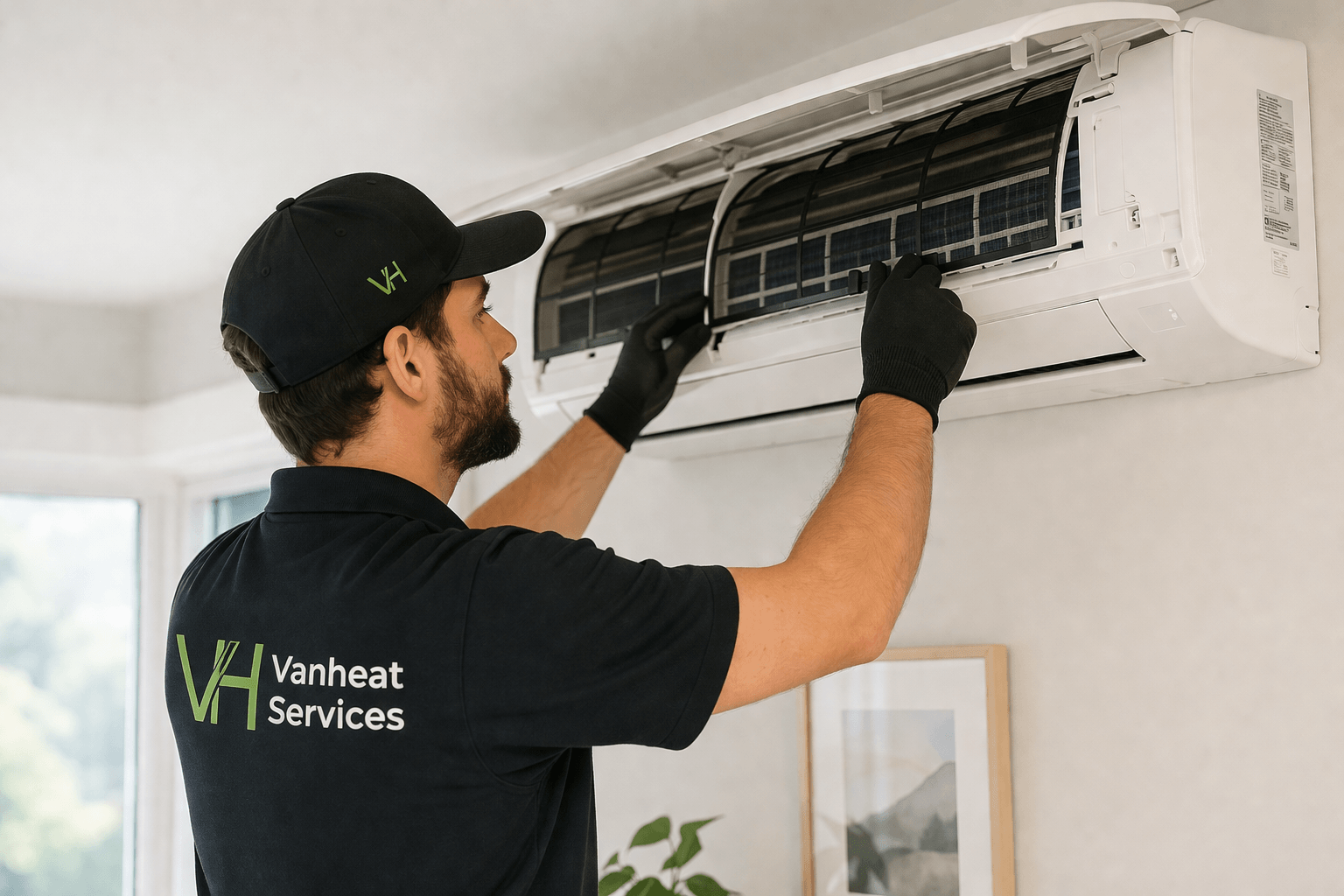
Yes, less than central HVAC but still important. Indoor head filters need cleaning every 1 to 3 months (a 5-minute task). The outdoor coil should be rinsed annually. The blower wheel and evaporator coil need professional deep cleaning every 2 to 3 years to prevent biofilm and mould growth. Skipping mini-split maintenance is the most common cause of premature failure and warranty disputes. See our guide on regular mini-split cleaning for the full schedule.
Can a mini-split replace my furnace entirely?
In most Vancouver homes, yes. A correctly sized cold-climate multi-zone mini-split can replace a furnace and central AC together, providing year-round heating and cooling from a single system. The trade-off: each room needs an indoor head (or ducted concealed unit), which is more visible than a single forced-air supply register. Some homeowners prefer a hybrid setup: mini-split for shoulder seasons and AC, gas furnace as backup for the coldest weeks. Per the FortisBC dual fuel rebate program, qualifying hybrid installations are eligible for up to $5,000 back.