



A dirty air filter cuts furnace efficiency by 5 to 15 percent and is the single most overlooked maintenance task in Vancouver homes. The filter costs $5 to $30. Skipping replacement to save that $30 costs you $75 to $225 per heating season in wasted gas, plus accelerated wear on your blower motor. This guide covers the actual replacement schedule, what MERV rating to use, and how to spot a filter that needs changing before your bills climb.
Content reviewed by Vanheat Services’ Red Seal certified HVAC technicians and Technical Safety BC licensed gas fitters. Last updated May 2026.
- 1-inch standard filter: Replace every 1 to 3 months during heating season
- 4-inch media filter: Replace every 6 to 12 months
- MERV rating: 8 to 11 standard, 11 to 13 for allergies or wildfire smoke
- Cost of skipping: 5 to 15% efficiency loss, $75 to $225 wasted per heating season
- Filter color check: Replace when medium gray, not when jet black
What Your Furnace Air Filter Actually Does
The furnace air filter does two jobs at the same time, and homeowners usually only think about one of them. Job one is air quality: the filter catches dust, pollen, pet dander, and (with the right MERV rating) bacteria and smoke particles before they recirculate through your home. Job two is mechanical protection: the filter keeps that same dust from coating the blower wheel and the heat exchanger inside the furnace.
When the filter is clean, both jobs happen invisibly. When it gets clogged, both jobs fail at once. Air quality drops because the filter cannot capture more particles. And the mechanical protection fails because dust starts bypassing the filter through the gaps where it doesn’t seat tight against the frame.
The filter is the single cheapest part of your furnace ($5 to $30) and the single most consequential maintenance task. Replace 1-inch filters every 1 to 3 months during heating season. Set a phone reminder.
How a Dirty Air Filter Cuts Furnace Efficiency
A clogged filter restricts airflow through the furnace. The blower has to run longer to deliver the same heat, the temperature rise across the heat exchanger climbs higher than spec, and the system either short-cycles on the high-limit safety switch or just runs inefficiently. The exact efficiency loss depends on how clogged the filter is.
| Filter condition | Efficiency loss | Cost on a $1,500 gas bill |
|---|---|---|
| Clean (replaced this month) | 0% | Baseline |
| Light dust (1 to 2 months in) | 2 to 5% | $30 to $75 |
| Moderately dirty (3 to 4 months in) | 5 to 10% | $75 to $150 |
| Visibly clogged (6+ months in) | 10 to 15% | $150 to $225 |
| Fully blocked (a year or more) | 15%+ plus mechanical risk | $225+ plus risk of blower motor failure ($600 to $1,200) |
A new filter pays for itself within the first month of replacement on a moderately dirty system. The math gets dramatically worse if the dirty filter causes a blower motor failure or triggers safety lockouts that require a service call. For a typical Vancouver home running its furnace from October through March, the difference between current and clogged filters can add up to $200+ across a single heating season.
How a Dirty Filter Affects Indoor Air Quality
The efficiency math is the headline reason to replace filters. The air-quality math is the quieter reason. A typical adult takes around 20,000 breaths in an 8-hour sleep period. Those breaths can contain elevated dust, pollen, pet dander, or wildfire smoke particles. The body responds with congestion, allergies, mouth breathing, headaches at startup, and dry throats.
Vancouver homes are particularly affected. Spring brings heavy alder and birch pollen (March through June). Late summer increasingly brings wildfire smoke. Winter inversions trap fine particulates indoors. According to Health Canada, indoor air quality has a measurable impact on respiratory health, sleep quality, and allergy symptoms. A current furnace filter handles all three seasonal patterns. A dirty filter handles none of them.
What MERV rating means
MERV (Minimum Efficiency Reporting Value) measures how small a particle the filter can catch. The rating system was established under ASHRAE Standard 52.2, which is what professional HVAC filter selection is based on. The number runs from 1 to 16 for residential filters. Higher numbers catch smaller particles, but they also restrict airflow more, which is why MERV 14+ filters are usually too aggressive for residential furnaces.
| MERV rating | Catches | Best for |
|---|---|---|
| MERV 4 to 6 | Pollen, dust, lint | Basic protection, cheap fibreglass filters. Adequate only with no allergies and no pets. |
| MERV 8 to 10 | Mould spores, pet dander, fine dust | Standard for most modern Vancouver homes. Pleated filters in this range balance airflow and filtration. |
| MERV 11 to 13 | Bacteria, virus carriers, smoke particles | Recommended for allergy or asthma sufferers, homes with pets, and during wildfire smoke events. |
| MERV 14 to 16 / HEPA | Submicron particles | Hospital-grade. Most residential furnaces cannot push air through these without restricted airflow that damages the blower. |
For deeper detail on how indoor air quality affects sleep and health, see how your HVAC system affects sleep quality.
Six Signs Your Furnace Filter Needs Replacement
If your furnace shows any of these symptoms, the filter is the first thing to check before booking a service call.
Visible dust and gray colour on the filter
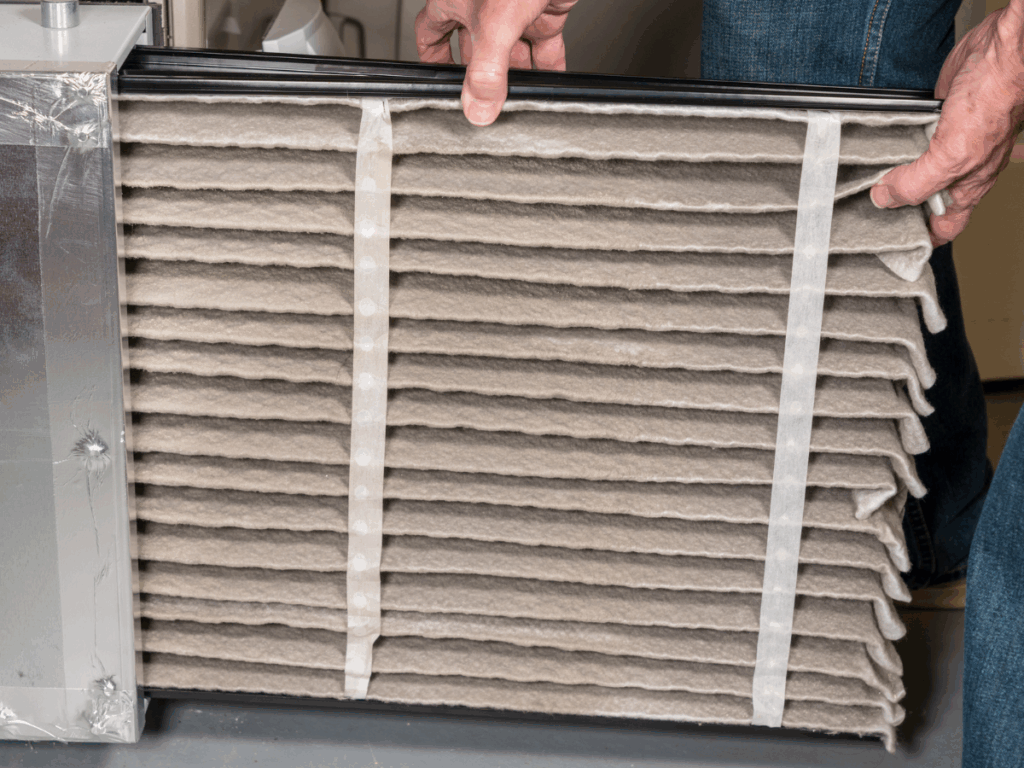
Pull the filter out and look at it against a white wall. Light dust is fine. Medium gray means replace now. Jet black means it’s been in there far too long, and you should check the blower wheel for dust accumulation at the next maintenance visit.
Reduced airflow from vents
Same fan speed setting, less air coming out of supply registers. Almost always a clogged filter, occasionally a duct issue. Replace the filter first, then book service if airflow doesn’t recover within one heating cycle.
Furnace running longer than usual
Your furnace used to reach the set temperature in 15 minutes. Now it runs 25 or 30. The clogged filter is forcing the system to work harder against restricted airflow.
Dust building up on shelves and screens
If your home feels dustier than usual, the filter is letting dust bypass it through gap leaks where it no longer seats tight. Visible dust within a week of cleaning is a clear signal.
Higher gas bill, same usage
Compare this month’s FortisBC bill to last year’s same month. A 10 to 15 percent jump with no rate change usually traces back to a clogged filter or fouled blower wheel. Both are caught during annual maintenance.
Furnace short-cycling on high-limit safety
The furnace turns on, runs briefly, shuts off, repeats. Restricted airflow causes the heat exchanger to overheat, triggering the high-limit safety switch. Replace the filter first. If short-cycling continues with a clean filter, book service.
If your Vancouver home is showing two or more of these signs, the filter may be the cheapest fix. But the underlying cause could also be a fouled blower wheel or scaled heat exchanger that filter replacement alone cannot reverse. A quick tune-up catches both at the same time. See what a 21-point furnace tune-up Vancouver visit covers.
How to Replace Your Furnace Air Filter
Replacement is a five-minute job that homeowners can do without tools. Most Vancouver furnaces have the filter in a slot on the side of the cabinet just before the blower compartment.
- Turn off the furnace at the thermostat or breakerSet the thermostat to ‘Off’ or flip the dedicated furnace breaker. This prevents the blower from pulling unfiltered air through during the swap.
- Locate the filter slotMost modern furnaces have a hinged door or sliding panel on the side of the cabinet labelled ‘filter’. Older furnaces have the filter in the return-air duct just upstream of the blower. Check your furnace manual if you cannot find it.
- Note the size and arrow direction before removingFilters have an airflow arrow printed on the frame. Note which way it points before pulling the old filter out. Filter dimensions are also printed on the frame, write them down.
- Slide out the old filterPull straight out, slowly. Avoid shaking it inside the cabinet, since that will dislodge dust into the blower compartment.
- Slide in the new filter, arrow pointing the same wayThe arrow always points toward the furnace (toward the blower), away from the return duct. New filter goes in the same orientation as the old one.
- Close the panel and turn the furnace back onReset the thermostat. Listen for the blower to come on within a minute. Air should flow more strongly from supply vents within the first cycle.
If you don’t want to do this yourself, every annual furnace tune-up in Vancouver includes filter replacement as part of the visit. See what a furnace tune-up Vancouver visit includes.
Book a Furnace Tune-Up with Filter Replacement Included
Annual furnace tune-ups from $129. 21-point inspection by Red Seal certified technicians, filter replacement included. Same-week appointments across Vancouver, Burnaby, North Vancouver and the Lower Mainland.
How Filter Maintenance Extends Furnace Lifespan
Furnace lifespan in Vancouver homes ranges from 15 years (heavily-used, neglected) to 25 years (well-maintained). The filter is the single largest variable in that range. Here is what happens to a furnace that runs on dirty filters for years on end.
The blower motor works harder against the airflow restriction, which shortens its bearing life. Dust that bypasses the clogged filter coats the blower wheel itself, forcing it out of balance and accelerating motor wear. The same dust coats the heat exchanger, reducing heat transfer and forcing the burners to fire longer. Combined, these effects shorten furnace life by 3 to 5 years on average.
The fix is simple: keep the filter current, book annual maintenance, and run the fan in ‘Circulate’ mode if your home has allergy or air-quality concerns. According to Technical Safety BC, annual professional inspection is the most reliable way to catch the dust accumulation issues that filter replacement alone cannot reverse. See annual furnace maintenance cost in Vancouver for what a yearly visit covers.
Furnace Filter Questions Vancouver Homeowners Ask
How often should I replace my furnace air filter?
Standard 1-inch filters need replacement every 1 to 3 months during heating season (October through March in Vancouver). Pleated 4-inch media filters last 6 to 12 months. Homes with pets, smokers, or allergy sufferers should replace at the shorter end of those ranges. Set a phone calendar reminder on the first of every month from October through March, check the filter, and replace if it looks dusty.
How much does a dirty air filter cost in efficiency loss?
A dirty air filter typically reduces furnace efficiency by 5 to 15 percent depending on how clogged it is. On a typical Vancouver gas bill of $1,500 per heating season, that is $75 to $225 in wasted gas. The filter itself costs $5 to $30. Skipping replacement to save $30 costs you $75 to $225 in higher bills, plus accelerated wear on the blower motor.
What MERV rating should I use for my furnace?
Most modern Vancouver furnaces support MERV 8 to 13 without restricting airflow. MERV 8 to 10 is standard for homes without allergies or pets. MERV 11 to 13 is recommended for allergy or asthma sufferers, homes with pets, and during wildfire smoke events. MERV 14+ filters typically restrict airflow on residential furnaces and can damage the blower motor over time. Check your furnace manual for the maximum MERV rating it supports.
Can a dirty air filter damage my furnace?
Yes, in three ways. First, restricted airflow forces the blower motor to run longer and harder, which shortens its lifespan and can cause premature failure ($600 to $1,200 to replace). Second, restricted airflow can cause the furnace to overheat, triggering the high-limit safety switch and shutting the system down. Third, dust that gets past a clogged filter coats the blower wheel and heat exchanger, reducing heat transfer and creating a maintenance liability. According to ASHRAE Standard 52.2, filter selection should match the equipment’s rated airflow capacity to prevent these issues, and according to Technical Safety BC, annual professional inspection catches them before they become emergencies.
Why does my house feel dustier when the filter is dirty?
Two reasons. First, a fully clogged filter starts letting dust bypass it through the gaps where the filter doesn’t seat tight against the frame. Second, dust that should have been caught keeps recirculating because the filter cannot capture more particles. By the time you notice extra dust on shelves and screens, the filter is well past replacement. The filter should look medium gray when due for replacement, not jet black.
Should I run the furnace fan continuously to filter air better?
Setting the furnace fan to ‘Circulate’ or ‘On’ mode keeps air moving through the filter even when no heating cycle is active, which dramatically improves indoor air quality. The trade-off is roughly $5 to $15 extra per month in electricity to run the blower continuously. For homes with allergies, asthma, or wildfire smoke concerns, the air-quality benefit usually justifies the cost. Just make sure your filter is current. Running the fan on a clogged filter wastes electricity without improving air quality.
Are reusable washable filters worth it?
Reusable filters cost $30 to $80 upfront and last 5 to 10 years, which is cheaper than replacing disposable filters monthly. The trade-off: most reusable filters are MERV 4 to 6, which is too low for households with allergies or pets. They also need to be fully dry before reinstalling. A damp filter restricts airflow and can grow mould. For most Vancouver homes, a high-quality disposable pleated MERV 11 filter replaced every 1 to 3 months delivers better air quality at similar long-term cost.
Where can I buy furnace filters in Vancouver?
Standard 1-inch filters are stocked at Home Depot, Rona, Canadian Tire, and most hardware stores. Specialty 4-inch media filters and high-MERV (11 to 13) pleated filters are available through HVAC supply houses or online. Vanheat Services carries common filter sizes on every service truck and replaces the filter as part of every annual maintenance visit. Bring the dimensions of your existing filter (printed on the side) when shopping.