



Seasonal AC maintenance in Vancouver should happen in late April or early May, before the first warm stretch of the year. Vancouver summers typically peak at 25 to 30 degrees Celsius, with heat dome events occasionally pushing 35 to 40 degrees. This guide covers the 7-step seasonal AC maintenance checklist, what homeowners can do themselves, what requires a professional, and the most common AC failures Vanheat sees during Vancouver summers.
Content reviewed by Vanheat Services’ Red Seal certified HVAC technicians. Last updated May 2026.
- 1.Clean or replace the air filters
- 2.Clear debris from the outdoor unit
- 3.Inspect indoor units for dust and mould
- 4.Test cooling performance before peak season
- 5.Flush the condensate drain line
- 6.Check thermostat and remote settings
- 7.Book a professional AC tune-up in Vancouver

231 reviews

Seasonal AC Maintenance: At-a-Glance
- Best timing: Late April to early May, before the first heat wave
- DIY tasks: filter cleaning, debris clearing, condensate flush, thermostat check
- Professional tasks: refrigerant levels, electrical, compressor, sealed-loop work
- Annual tune-up cost: $129 to $229 in Vancouver
- Efficiency impact: dirty filters reduce HVAC efficiency 5 to 15 percent (per ENERGY STAR)
Why Seasonal AC Maintenance Matters in Vancouver
Vancouver doesn’t have Phoenix or Toronto’s cooling demands, but our summers have changed. According to Environment Canada, the 2021 heat dome pushed temperatures across Metro Vancouver to 40+ degrees Celsius for nearly a week. Heat dome events are now expected every 2 to 3 years, and “normal” summers regularly hit 28 to 32 degrees.
For ductless mini-split air conditioners, central AC, and heat pumps in cooling mode, this matters in three ways:
- Run-time has roughly tripled. Many Vancouver AC systems were originally sized for the shorter cooling seasons of 10 to 15 years ago. Current cooling-season run-time is often 2 to 3 times what was historically typical. That accelerates wear on capacitors, fans, and compressors.
- Heat-stress failures cluster on the hottest days. Capacitor failures, refrigerant leaks at line-set joints, and compressor short-cycling all spike during heat waves, exactly when getting a service appointment is hardest.
- Filter loading is faster in summer. Pollen, dust, and particulate from drier air load filters 2 to 3 times faster than winter. A filter changed in March is often saturated by June.
Seasonal maintenance done in spring catches the issues that would otherwise become emergency calls in July.
The 7-Step Seasonal AC Maintenance Checklist
Six of these seven steps are homeowner-doable. The seventh (professional tune-up) handles everything that requires Red Seal certification or refrigerant work, both of which are legally restricted to licensed technicians in BC.
Clean or replace the air filters
Dirty filters reduce airflow and force the system to run longer to hit the same temperature. According to ENERGY STAR, dirty filters can cut HVAC efficiency by 5 to 15 percent.
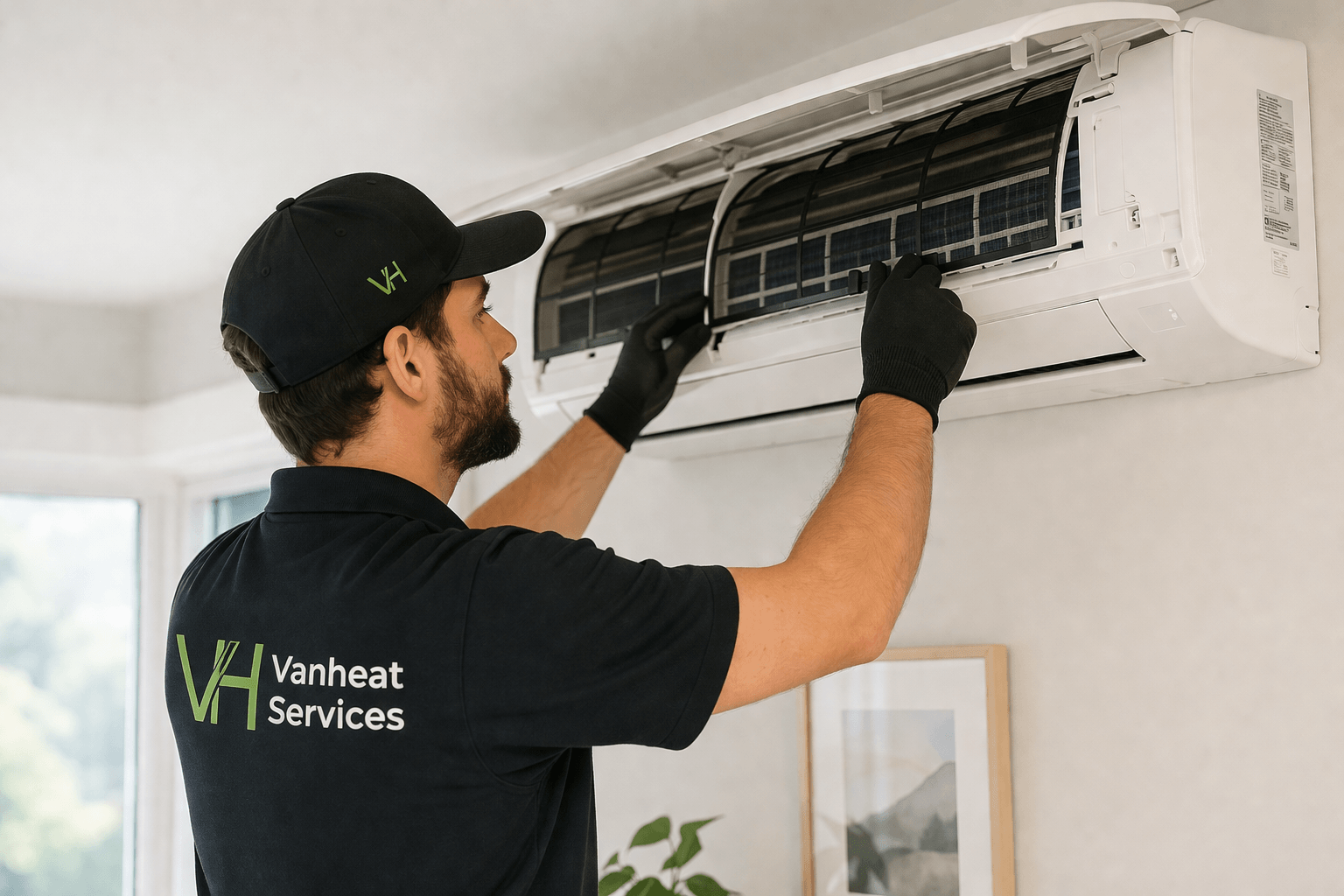
- Locate the indoor unit filter (lift the front panel of the mini-split head; remove the air filter from the slot)
- Rinse with warm water in a sink or bathtub
- Air dry completely before reinstalling. Never use a hair dryer
- Replace the filter if it shows tears, has a permanent musty smell, or is more than 5 to 7 years old
- For central AC: replace the disposable furnace filter (1-inch standard, MERV 8 to 11 recommended)
During cooling season, repeat this every 2 to 4 weeks. Skip a month and you’ll feel the difference in cooling performance and your hydro bill. See how dirty filters impact HVAC efficiency.
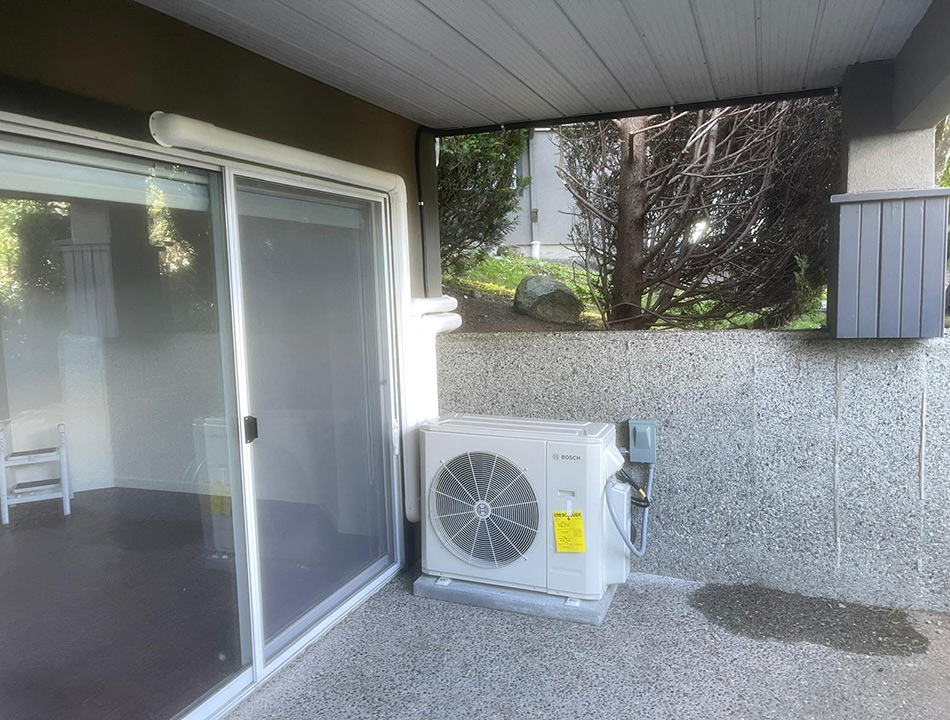
Check the outdoor unit for debris
Leaves, dirt, cottonwood fluff, and grass clippings clog the outdoor condenser coil. A blocked condenser cannot reject heat, which makes the compressor work harder and shortens its life.
- Turn off power at the disconnect (usually a small grey box mounted near the outdoor unit)
- Clear vegetation within 60 cm of the unit on all sides
- Remove leaves, debris, and cottonwood from the top grille
- Hose down the condenser coil from the inside-out using a garden hose at low pressure
- Avoid pressure washers, they bend the aluminium fins permanently
Bent fins reduce airflow through the coil. If you see large patches of bent fins, a fin comb (about $15 at any HVAC supply) can straighten them.
Inspect the indoor units for dust and mould
Vancouver’s wet shoulder seasons promote mould growth inside indoor heads, especially mini-split air handlers that sit unused in cooling mode for 8 months. Mould inside an air handler ends up in your indoor air every time the unit runs.
- Wipe down the front panel and vents with a damp microfibre cloth
- Use a vacuum with a soft brush attachment to remove dust from the air outlet louvres
- Look inside the unit (with the panel removed) for black spots or a musty smell, both indicate mould
- If you see mould or smell mildew, schedule a professional deep clean before running the system
Once mould is established inside an indoor head, surface-cleaning the front panel does not solve it. The blower wheel and evaporator coil need a chemical clean that requires removing the air handler housing. Book a professional mini-split deep clean if you suspect mould before running the system in cooling mode.
Test system performance before you need it
Once filters are clean and units are checked, run a controlled test to confirm everything works.
- Switch the system to cooling mode
- Set the thermostat 3 to 5 degrees below the current room temperature
- Let it run for 15 to 20 minutes
- Check that the air coming out is consistently cool (8 to 14 degrees colder than the return air is normal)
- Listen for grinding, clicking, or buzzing. None of these are normal
- Check the condensate drain line outside for water flow during the test
If the air feels less cool than it should, or you hear unusual noises, do not wait. Catching a refrigerant leak or capacitor weakness in May is a $250 to $650 repair. The same issue in mid-July, after the system has run hot for weeks, often becomes a $1,500+ compressor replacement. Weak cooling in May usually becomes a breakdown in July. Book a heat pump or AC repair at the first sign rather than waiting through the heat wave.
Check and clean the condensate drain
The condensate drain carries water away from the indoor unit’s evaporator coil. A clog backs water up into the indoor head, which causes water leaks indoors and (in some systems) automatic shutdown to prevent flooding.
- Locate the drain line (usually a flexible plastic tube exiting the wall near the outdoor unit)
- Use a wet/dry vacuum at the outdoor end to suck out blockages
- Flush the line from the indoor end with a 50/50 mix of warm water and white vinegar
- Watch for water flow at the outdoor end. If nothing comes out, there’s still a blockage
This is the single most common cause of “AC suddenly stopped working” calls in Vancouver during August. It’s a 5-minute fix as preventive maintenance and a much bigger headache after the indoor unit has dripped through your ceiling.
Check the thermostat and remote settings
After 8 months of disuse, batteries die and settings drift. The thermostat is the cheapest piece of the system but it’s the brain that runs everything else.
- Replace remote control batteries (most mini-splits use AAA)
- Confirm the cooling schedule matches your current routine (work from home days, school schedules, etc.)
- For smart thermostats: verify Wi-Fi connectivity and that the app shows the system online
- Set a reasonable cooling baseline (24 to 26 degrees Celsius for most Vancouver homes)
Setting the thermostat too low (18 to 20 degrees) doesn’t cool the home faster. It just runs the system longer at maximum capacity, which spikes your hydro bill without any temperature benefit.
Schedule a professional AC tune-up in Vancouver
The first six steps cover what a homeowner can safely do. The seventh is the work that requires a Red Seal certified HVAC technician and Technical Safety BC licensed gas fitter (for systems with gas backup heat). AC tune-up Vancouver homeowners can book runs $129 to $229 depending on system type. See full annual maintenance cost breakdown.
A professional tune-up includes:
- Refrigerant level check. According to Technical Safety BC, refrigerant work in BC is legally restricted to licensed technicians. Low refrigerant indicates a leak that needs sealing, not just topping up.
- Electrical connection inspection. Capacitor testing, contactor wear inspection, and tightening loose connections that cause arcing.
- Compressor function test. Amp draw measurements compared to manufacturer spec, listening for bearing wear, checking start-up behaviour.
- Indoor coil deep clean. If buildup is visible, a coil cleaner application removes dust and biological growth that homeowner cleaning can’t reach.
- Manufacturer warranty registration. Documents the maintenance against the install record so warranty stays valid.
A tune-up runs $129 to $229 in Vancouver depending on system type. The visit usually pays for itself the first summer through restored efficiency and avoided emergency calls.
DIY vs Professional: Which Tasks Belong Where
Not every maintenance step is appropriate for a homeowner. Here’s the line we draw based on what’s safe, what’s legal, and what tools the work requires.
| Task | Who does it | Why |
|---|---|---|
| Filter cleaning | Homeowner | Simple, no tools required |
| Outdoor debris clearing | Homeowner | Garden tools only, power off at disconnect |
| Surface dust on indoor heads | Homeowner | Damp cloth + vacuum, no panel removal |
| Condensate drain flush | Homeowner | Wet/dry vac and vinegar, no tools beyond that |
| Thermostat / remote check | Homeowner | Battery replacement and settings only |
| Performance test (visual + listening) | Homeowner | No equipment needed, just observation |
| Refrigerant level check or top-up | Professional only | Legally restricted in BC (Technical Safety BC) |
| Electrical capacitor testing | Professional only | High voltage, capacitor discharge risk |
| Compressor diagnostics | Professional only | Multi-meter testing, manufacturer-specific specs |
| Indoor coil deep clean | Professional only | Requires removing the air handler housing |
| Sealed-loop refrigerant work | Professional only | Requires recovery equipment and licensing |
The reason most manufacturer warranties require annual professional maintenance is that several of these checks (refrigerant pressure, electrical, compressor) cannot be done by a homeowner and indicate problems before they cause failures.
Vanheat Services offers seasonal AC tune-ups across Metro Vancouver from $129. Red Seal certified, Technical Safety BC licensed gas fitters. Book at (604) 281-4790 or through the online form. Annual tune-up satisfies most manufacturer warranty requirements and includes documented commissioning report.
Most Common AC Failures We See in Vancouver Summers
Based on the calls Vanheat handles each summer across Vancouver, Burnaby, and the North Shore, the same five issues account for roughly 80 percent of cooling-season service requests.
Capacitor failures (30 to 40 percent of summer calls)
Capacitors store the electrical charge that starts the compressor. Heat stress is the primary failure mode. Capacitors rated for 35 degrees Celsius operating temperature get pushed to 50+ degrees inside an outdoor unit during a heat wave. Symptom: the compressor hums but won’t start, or shuts off after 30 seconds. Repair cost: $250 to $450, usually same-visit if caught early. Same-day capacitor replacement available.
Refrigerant leaks at line-set joints
The line set is the pair of insulated copper pipes that carry refrigerant between the indoor and outdoor units. The flare joints at each end loosen over years of thermal expansion. Symptom: the system runs but doesn’t cool effectively, or ice forms on the indoor coil. Detection requires electronic leak detection and refrigerant gauges (professional only). Repair cost: $400 to $1,200 depending on leak severity.
Clogged condensate drains
Algae and biological growth in the drain line during humid weather. Symptom: water dripping from the indoor unit, or sudden auto-shutdown with a drain-pan-full error code. This is the same drain you flushed in step 5 above. If you skipped that step, this is likely your service call. Repair cost: $150 to $250.
Frozen evaporator coil
Restricted airflow (dirty filter, blocked vents, low fan speed) causes the evaporator coil to drop below freezing. Ice builds up, blocks airflow further, and the system fails completely. Symptom: warm air from vents, visible ice on the indoor coil or refrigerant line. Fix: turn the system off for 4 to 6 hours to thaw, then replace the filter. If it freezes again, refrigerant or fan motor is the cause.
Compressor short-cycling from low refrigerant
Low refrigerant causes the system to start and stop rapidly. Each start-up draws 3 to 5 times the running current, which damages the compressor. Symptom: system runs for 1 to 2 minutes, shuts off, restarts. Long-term: compressor failure costing $1,500 to $3,500 to replace. Catching the underlying refrigerant leak early is far cheaper.
All five of these are either prevented or detected early by the seasonal maintenance checklist above. The system Vanheat tunes up in May rarely shows up on the August emergency call list.
Seasonal AC Maintenance: Common Questions
When should I do seasonal AC maintenance in Vancouver?
Seasonal AC maintenance in Vancouver should be done in late April or early May, before the first warm stretch of the year. Vancouver summers typically see peak temperatures of 25 to 30 degrees Celsius, with heat dome events pushing into the 35 to 40 degree range every 2 to 3 years. Doing the maintenance in spring catches problems before the system is under load. Waiting until the first heat wave usually means joining a service queue when every contractor in the Lower Mainland is booked.
How often should I clean my mini-split air filters?
Mini-split air filters should be cleaned every 2 to 4 weeks during active cooling season (May to September) and once a month during heating season. According to ENERGY STAR, dirty filters can reduce HVAC efficiency by 5 to 15 percent. Most ductless mini-split filters are washable mesh that can be rinsed under warm water. Replace the filter if it shows tears, has a permanent mould smell, or is more than 5 to 7 years old.
Can I do seasonal AC maintenance myself?
Most of the seasonal AC maintenance checklist can be done by a homeowner: filter cleaning, outdoor unit debris clearing, indoor unit dusting, condensate drain flushing, thermostat checks. The work that requires a professional includes refrigerant level testing, electrical connection inspection, compressor diagnostics, and any work involving the sealed refrigerant loop. According to Technical Safety BC, refrigerant work in BC requires a licensed technician.
How much does professional AC maintenance cost in Vancouver?
Annual professional AC tune-up in Vancouver runs $129 to $229 depending on the system. Single-zone mini-split tune-up typically runs $129 to $169. Multi-zone mini-split (multiple indoor heads) runs $189 to $229. Whole-home AC plus furnace combined visit runs $229. The tune-up usually pays for itself through restored efficiency: a properly maintained system uses 5 to 15 percent less electricity than a neglected one.
What are the most common AC problems in Vancouver summers?
The most common AC failures we see in Vancouver during summer are: capacitor failures from heat stress (about 30 to 40 percent of summer service calls), refrigerant leaks at line-set joints (especially in systems 8+ years old), clogged condensate drains causing water leaks indoors, dirty filter restriction causing the system to ice over, and compressor short-cycling from low refrigerant. Most of these are preventable with seasonal maintenance.
Does seasonal AC maintenance affect manufacturer warranty?
Yes. Most mini-split, central AC, and heat pump manufacturers (Mitsubishi, Daikin, Lennox, Bosch, Carrier) require annual professional maintenance to keep the warranty valid. Skipping maintenance and then making a warranty claim usually results in denial. Vanheat provides documented annual tune-ups that satisfy manufacturer warranty requirements and registers the maintenance against the original install.
Book Your Seasonal AC Tune-Up
From $129. Red Seal certified, Technical Safety BC licensed gas fitters. 4.9 stars, 231 Google reviews. Documented annual tune-up satisfies manufacturer warranty.